
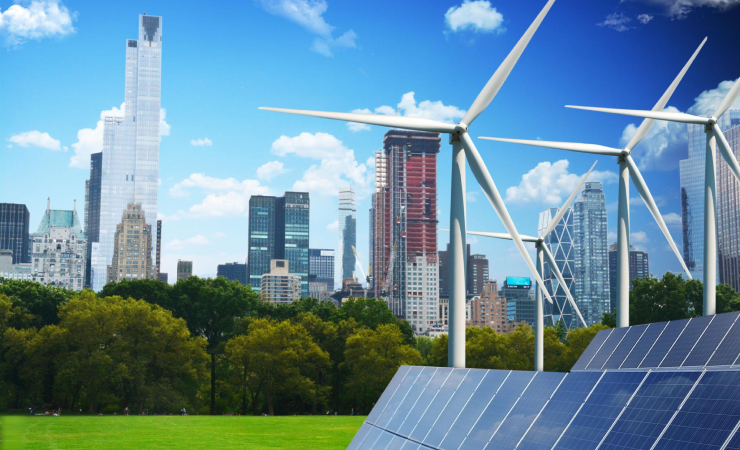
For decades, global power was shaped by oil, gas, minerals, military strength, manufacturing scale, and technological dominance. Countries that controlled energy supply, industrial production, and strategic resources were able to influence the direction of global trade and diplomacy.
But the next power race may not be led only by fossil fuels or traditional industry.
It may be led by clean technology.
Solar panels, batteries, electric vehicles, green hydrogen, heat pumps, critical minerals, clean industrial systems, smart grids, and climate infrastructure are no longer just environmental tools. They are becoming instruments of national competitiveness, economic influence, trade advantage, and geopolitical power.
This is why clean tech is no longer just a sustainability story. It is becoming a global strategy story.
A recent example makes this shift very clear. In May 2026, HSBC announced a $4 billion Sustainability and Transition Credit Facility to support the global expansion of mainland Chinese companies working in clean and transition technologies, including renewable energy, electric vehicles, artificial intelligence, data centres, and related sectors. Reuters reported that the facility is designed to help Chinese clean tech companies scale internationally with extended credit terms, faster approvals, and tailored financial solutions.
This is not just a banking announcement. It is a signal.
When major financial institutions begin creating dedicated facilities for clean tech expansion, they are acknowledging that the green economy is no longer a future possibility. It is already a competitive marketplace. The countries and companies that control clean technologies will not only shape emissions targets. They will shape supply chains, jobs, exports, infrastructure, and influence.
China understood this early.
According to the International Energy Agency, clean energy technology manufacturing remains highly geographically concentrated, with China playing the dominant role in most supply chain stages. The IEA notes that China accounts for around 85% of solar supply chain production capacity and around 80% of lithium-ion battery supply chain production capacity, with even higher shares in areas such as PV wafers and anode materials.
These numbers explain why clean tech has become a power race.
If one country dominates the production of solar panels, batteries, EV components, and key clean energy supply chains, it gains influence over the technologies the rest of the world needs to decarbonise. The energy transition may reduce dependence on oil and gas over time, but it can create new dependencies around manufacturing, minerals, batteries, grids, and industrial capability.
That is the uncomfortable truth behind the clean economy. A greener world does not automatically mean a less competitive world. It may simply change what nations compete over.
Electric vehicles are a good example. EVs are often discussed as consumer products — cars that reduce emissions, lower fuel dependence, and modernise mobility. But behind every EV is a much larger industrial system: battery chemistry, lithium processing, charging infrastructure, software, semiconductors, rare earth supply chains, manufacturing capacity, government incentives, and export strategy.
The IEA has projected strong growth in global EV sales, while recent reporting also highlights China’s scale in EV production and exports. A Financial Times summary of IEA projections noted that China produced nearly three-quarters of the world’s EVs in 2025 and doubled its EV exports amid intense domestic competition.
This is why EVs are not only about cleaner transport. They are about who owns the next era of mobility.
The same is true for solar. Solar energy is one of the most important technologies in the global energy transition because it is increasingly affordable, scalable, and deployable across different markets. But solar’s rise is also closely connected to manufacturing dominance. A country that controls solar manufacturing does not just sell panels. It helps define the economics of future power systems.
The Financial Times recently highlighted that solar could become the world’s largest source of electricity by 2032 under BloombergNEF’s economic transition scenario, supported by China’s mass production of solar panels, falling costs, and battery storage improvements.
This is why clean tech competition is not limited to climate policy. It is now tied to industrial policy.
Europe has recognised this clearly. The European Commission launched the Clean Industrial Deal in February 2025, describing it as a plan to turn decarbonisation into a driver of growth for European industries. The deal focuses on lowering energy prices, creating quality jobs, supporting competitiveness, and helping European companies respond to high energy costs and fierce global competition.
That language matters. Europe is not speaking only about emissions reduction. It is speaking about competitiveness.
The United States has taken a similar direction through the Inflation Reduction Act. The U.S. Department of Energy describes the IRA as the largest climate and energy investment in American history, with the aim of advancing domestic clean energy manufacturing and strengthening America’s position as a world leader in clean energy.