

Why the new wave of natural-capital finance stakes its credibility on a single question: Can money protect the very thing its value depends on?
Forests are probably humanity's oldest asset. For centuries they produced timber, food, medicine, water and fertile soil, and sustained entire economies long before stock exchanges existed. And yet, for the modern investor, a forest has been almost impossible to own well.
The reason is uncomfortable. For decades, "investing in a forest" meant, in practice, one of three things. Cutting it down – turning a living ecosystem into a one-time cash flow. Speculating on the land – waiting for the price to rise while the forest, at best, just sits there producing nothing. Or, more recently, buying carbon credits whose relationship to an actual tree is, too often, vague, unverifiable, and scandal-prone. In all three cases, capital and nature ended up on opposite sides of the table.
Today we have a chance to change that. But only if we're honest about what's at stake.
The living asset
The difference between a forest and almost any other asset is that a forest grows. It does not depreciate over time; it appreciates biologically. A tree of a fine species is not worth less each year, like a machine or a vehicle. It is worth more because it accumulates wood, captures carbon, stabilizes soil, and supports biodiversity. Time, the enemy of most assets, is the forest’s ally.
That's the promise of investing in forests: a real, tangible, productive asset whose value is anchored in a natural process rather than a financial narrative. But that promise comes with a condition rarely said out loud: the financial value is only real if the ecological outcome is real too. A tree that doesn't survive, doesn't grow, isn't part of a healthy ecosystem, is not an asset. It's a spreadsheet.
This is where the conversation gets serious.
Measurement changes everything (and why it isn't enough)
Historically, the forest was "unbankable" for a practical reason: it couldn't be measured precisely, continuously, and cheaply. Without reliable measurement, there is no reliable valuation; without valuation, there is no serious investment; without investment, the standing forest almost always looked worth less than the felled one. That was, for a century, the original flaw.
That has now changed. Digital measurement – satellite imagery, sensors, tree-by-tree monitoring, what's known as dMRV (digital measurement, reporting and verification) – makes it possible today to know, in an auditable way, how many trees there are, how much they've grown, how many survive, and what ecosystem services they're generating. For the first time, ecological performance and financial performance can rest on the same data.
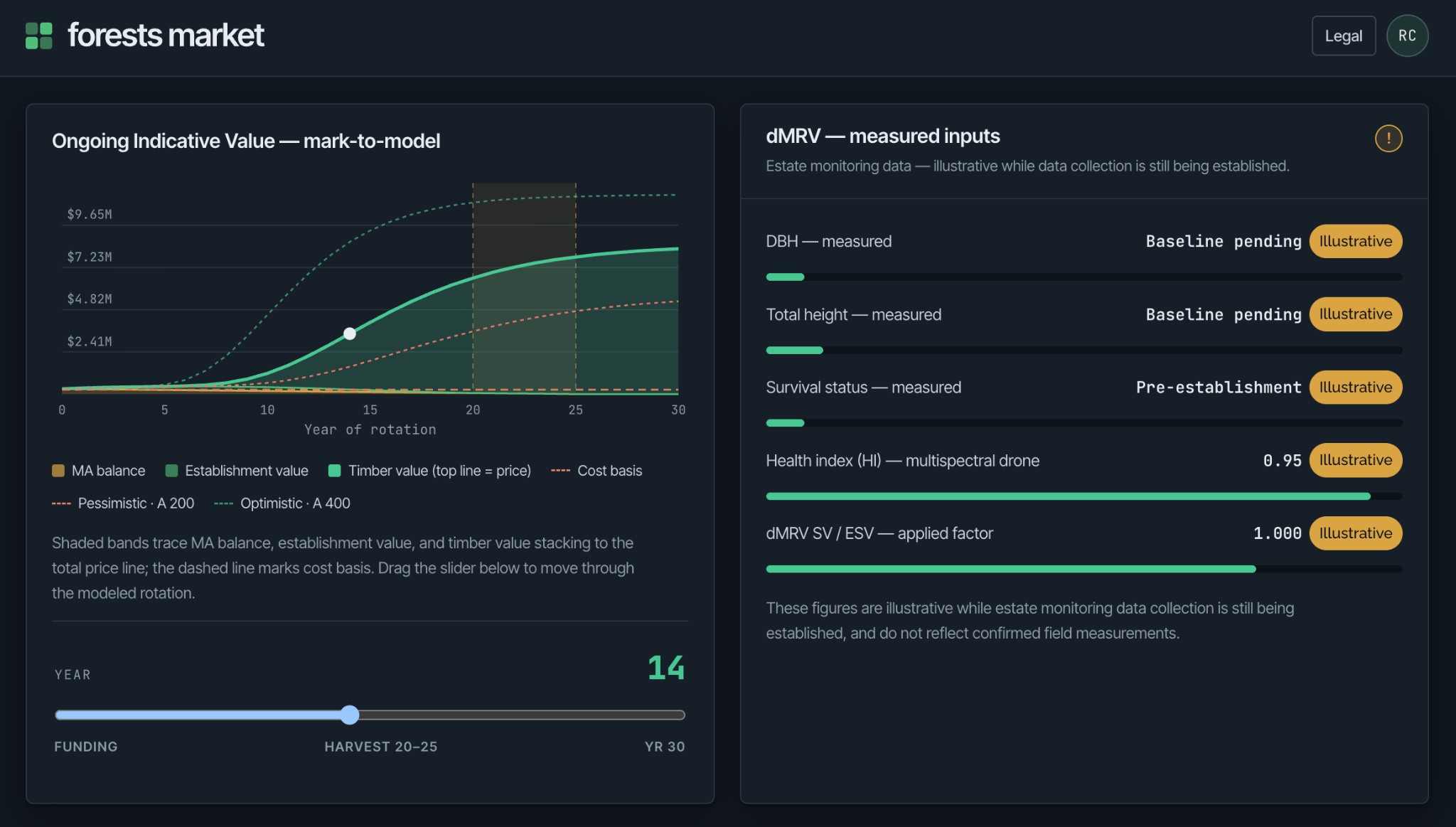
What to look for: where forest growth, survival, and financial value meet.
And yet, I want to be clear about something the natural-capital euphoria tends to skip: measurement alone does not solve the underlying problem. Measuring a forest better does not stop capital from optimizing it in the wrong direction. We can measure, with surgical precision, a fragile monoculture planted to maximize a number while destroying the biodiversity it claimed to protect. Measurement is a necessary condition, not a sufficient one.
The real risk: financialization that decouples
Recently, an investor asked me the best question I've received on this subject, over LinkedIn: as natural capital becomes measurable and investable, how do you prevent financialization from optimizing the value of the asset while losing sight of the ecological outcomes that created that value in the first place?
It's the right question, and it deserves an answer without marketing.
The danger isn't investing in forests. The danger is decoupling. The moment the financial instrument (the token, the credit, the certificate, the share) separates from the real asset and starts to live a life of its own. When that happens, the market stops rewarding the healthy forest and starts rewarding the number, and the number can always be inflated faster than a tree grows. The whole recent history of low-quality carbon credits is, at bottom, a story of decoupling. The only structural defense is to design the investment so the ecological and financial outcomes are inseparable, not merely compatible. In practice, that means three things.
First, the asset must be the living tree, not an abstraction floating above it. If what you own is the tree – measured, located, with secured land tenure – and not a derivative hovering over it, then you cannot grow the financial value without actually growing the forest.
Second, the same data must underpin both. If the valuation is built on the dMRV that also reports survival and growth, there are no two versions of the truth: you can't dress up the return without exposing the real ecological outcome.
Third, the horizon must be long by design. Forestry punishes short-term extraction; the tree harvested too early is worth less. A long horizon naturally filters out the "optimize and exit" behavior that financialization usually rewards.
The case we're building
I write this not as a neutral observer, but as someone who has staked his work on this thesis. At Forests VC, we are restoring cocobolo (Dalbergia retusa), a native fine hardwood classified as Critically Endangered by the IUCN after decades of logging, in the tropical dry forest of Guanacaste, Costa Rica. Each investor owns real trees, measured one by one, within a transparent structure, with the land held in trust.
I don't offer this as proof that we've solved it, we haven't entirely. And I'm wary of anyone who claims otherwise. I offer it because it embodies the wager: that it's possible to build a vehicle where recovering a threatened species and generating a real return aren't competing goals but the same variable. The day restoring the forest stops being a secondary "co-benefit" of the return and becomes its source, we'll have changed something important.
The real test
Over the next decade, investing in forests will be one of the clearest tests of whether finance can align with nature instead of consuming it. For the first time, we have the tools: real assets that appreciate on their own, measurement that is no longer an excuse, and structures that can keep the instrument bonded to the ecosystem.
What we don't yet have, guaranteed, is discipline. Because the temptation, as old as capital itself, will always be to optimize the number and forget the forest. This generation of investors, managers, and founders isn't only tasked with making forests investable. It's tasked with making them investable without betraying what made them valuable in the first place.
And that, more than any return, is the metric we should let ourselves be measured by.
About the Author:
Ronny Castillo is the founder of Forests VC, a real-asset manager focused on forestry and agriculture. This article reflects a personal opinion for informational purposes and does not constitute an offer of securities or investment advice.